On Katy clay, gutters are a foundation problem
The most expensive gutter mistake in this region is sizing a system for average rainfall.
September 8, 2026 · 3 min read
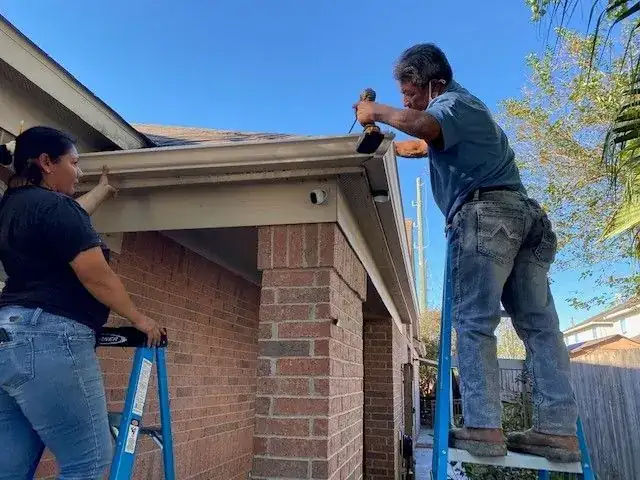
Gutters are the least interesting part of a house and one of the few parts that can quietly cost you a foundation. That is not an exaggeration used to sell gutter work. It is a straightforward consequence of what the soil around Katy does when it gets wet.
What clay soil does
The soil through much of this region is clay heavy. Clay expands when it takes on water and contracts when it dries out. That is normal and slabs are built expecting some of it.
What they are not built expecting is one section of soil going through that cycle far harder than the rest. If a gutter overflows in the same corner every heavy rain, that corner of soil swells while the far side of the house does not. Repeat that across a few Gulf Coast summers and the movement stops being uniform. Uneven movement under a slab is what produces the cracks people eventually call somebody about.
Why systems end up undersized here
The common failure is a gutter system specified for average rainfall rather than the rainfall this region actually delivers. Averages are not the problem. A single intense downpour is, and this area gets those.
When a run cannot carry the volume, water goes over the front edge in a sheet. It lands directly against the foundation, on the siding, and through the landscaping. Nothing about the gutter looks broken. It is simply too small, or pitched so the water never reaches the downspout fast enough.
Sizing and pitch are the job
Most residential properties use five inch gutters. Larger homes and commercial roofs need bigger, sized against the roof area feeding each run rather than against what the house had before.
Pitch matters just as much and gets less attention. A run has to fall consistently toward its downspout. A flat section holds water, and standing water in a gutter is both dead capacity and a slow way to wear the system out.
Five feet from the foundation
Getting water into the gutter is half of it. Getting it away from the house is the other half, and it is where most systems are left unfinished.
Downspouts should discharge water at least five feet from the foundation. A downspout that ends at the base of the wall has moved the water twenty feet along the roof to deposit it in exactly the place you did not want it. Extensions are cheap. Foundation repair is not.
Why seamless runs
Sectional gutters are joined every few feet, and every joint is a future leak. The sealant ages, the sections move slightly with heat, and eventually water finds the seam. It usually starts as a drip nobody notices from the ground.
Seamless gutters are formed to length on site with a gutter machine, so there is no joint along the run at all. The only connections are at corners and outlets. It is a straightforward improvement and it is why the machine comes to the house rather than the gutter arriving on a truck in lengths.
What to look at on your own house
You do not need a ladder for most of this. In the next heavy rain, walk around and look for water coming over the front edge rather than out of the downspout. That is the sign of an undersized or blocked run.
Afterwards, look for soil erosion channels near the foundation, splash staining on siding, and mulch that has been pushed out of a bed. All three mean water has been landing where it should not. And look at where each downspout actually ends, because if it stops at the wall, that is the cheapest thing on this list to fix.
ProRoofs and Restoration — (281) 994-9244
Call (281) 994-9244More articles
What a roof inspection report actually contains
Most homeowners have never been shown a proper one, which is exactly why weak reports keep getting accepted.
Hail damage in Katy: what to do in the first week
Most of the mistakes that sink a hail claim happen in the first few days, before anyone has climbed on the roof.